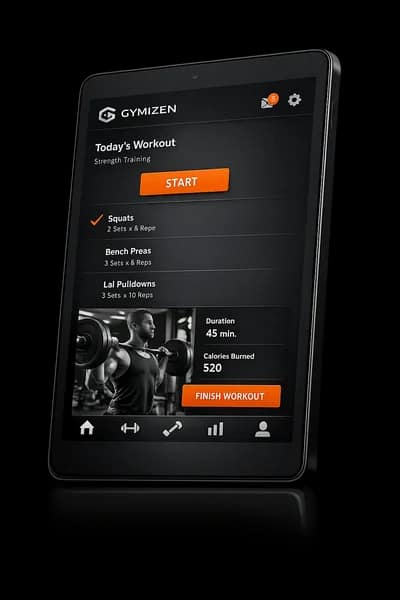


This guide shows how to roll out a Lead → Trial → First Class → Membership workflow in Gymizen with approval gates where you need control (discounts, plan changes, comped credits) and automation where you need speed (follow-ups, reminders, handoffs). It’s built for boutique fitness operators—CrossFit gyms, yoga and pilates studios, martial arts schools, and boxing gyms—who want higher conversion without turning the front desk into a guessing game.
What you’ll have at the end (definition of “done”)
- One intake path for new leads (no duplicate records, no “text me your name” chaos).
- Standardized trial products with clear eligibility (who gets what, for how long, and what happens next).
- Automated follow-up sequences that support staff—without spamming members or sending the wrong offer.
- Role-based handoffs (front desk, coaches, sales/manager, owner) with concrete “next action” ownership.
- Approval-gated conversions so plan overrides, discounts, and comp decisions are controlled and auditable.
- QA checks that catch the most common leak points: untagged leads, expired trials, unbooked first class, “ghosted” follow-ups.
Prerequisites (do these before Day 1)
- Workspace basics are set: locations, business hours, staff roster, and baseline notifications.
- Scheduling is usable: at least one bookable class type (or appointment/intro session) exists and appears to members.
- Payments are ready if your trial is paid (even if it’s $10): payment method, tax rules (if applicable), refund rules.
- Owner alignment on three non-negotiables: (1) your trial offer(s), (2) conversion policy, (3) discount authority.
If you’re not there yet, queue those items first—otherwise your team will “solve” missing configuration with one-off workarounds (and then you’ll be untangling it for months).
Roles & responsibilities (so the workflow doesn’t depend on one hero)
Assign these roles before you touch configuration. In Gymizen, approvals and automations work best when ownership is explicit.
- Owner: final sign-off on trial catalog, conversion rules, and who can approve exceptions.
- General Manager / Ops Manager: project lead; builds the workflow; runs QA; trains staff; monitors early results.
- Front Desk / Member Experience: executes daily lead follow-up, booking, and “first class readiness” checks.
- Coach / Instructor: executes first-class experience; marks attendance; leaves quick notes; triggers post-class handoff.
- Sales (if you have it): handles membership conversations; owns conversion queue; requests approvals when needed.
Recommended defaults (operator-tested starting point)
You can absolutely customize, but starting with defaults keeps rollout fast and minimizes “policy-by-opinion.”
- Trial menu: 1–2 trial options max (example: “Intro Class” + “7-Day Starter”). More than two options increases decision paralysis and creates inconsistent comps.
- Trial window: 7–10 days is long enough to book, short enough to keep urgency.
- Follow-up cadence: 3 touches in first 72 hours (mix of text/email), then 2 touches over the next 7 days.
- Handoff rule: coach flags “great fit / needs follow-up / not a fit” immediately after first visit.
- Approval gates: any price override, any comped trial, any membership discount beyond a small predefined threshold requires manager approval; anything beyond that requires owner approval.
- Conversion objective: don’t optimize for “paid in full today.” Optimize for “booked next session + clear recommendation + next step scheduled.” Gymizen makes this measurable when you standardize tags and stages.
The workflow you are building (map it before you configure it)
Write your workflow as a simple chain. Every step needs: owner, trigger, next action, and (optionally) an approval gate.
- Lead created (web form, call, walk-in, referral) → stage = New Lead.
- Eligibility check → apply trial (paid or comped). Approval gate if comped.
- Booking → first class/intro scheduled; confirmations sent.
- Attendance → coach marks attendance + quick note.
- Post-first-class follow-up → recommendation + next booking.
- Conversion → membership purchase. Approval gate if discount/override.
- Onboarding → member app + expectations + first-30 plan (handoff to retention workflow).
Implementation principle: automation should move the ball forward, approvals should prevent irreversible damage (bad pricing, messy membership history, uncontrolled comps).
14-day rollout timeline (with setup steps, training, and QA)
This timeline assumes you’re running your business while implementing. If you have dedicated implementation time, you can compress it—but don’t skip QA days.
Days 1–2: Define your trial catalog + conversion policy (owner + manager)
Decide what you’re actually selling in the “trial” period. Your team will follow whatever is easiest—so make the right thing the easy thing.
- Choose trial types (1–2 max) and write eligibility rules in plain language (e.g., “one per person, valid for local residents, expires in 10 days”).
- Decide comp policy: who can comp a trial, for whom, and why (injury return, service recovery, staff referral, etc.).
- Define discount authority (example: front desk can’t discount; manager can approve up to X; owner approves anything beyond X).
- Define “conversion”: what counts as success (membership purchased, pack purchased, next class booked, etc.).
Days 3–4: Configure lead intake + required fields (manager)
Your first retention win is clean identity: one person, one record, with consistent contact permissions. If your intake is sloppy, every automation becomes risky.
- Standardize lead sources (Website, Walk-in, Referral, Social, Partner, Event). Keep the list short so staff uses it.
- Require these fields for a lead to be “actionable”: first name, last name, mobile phone, email (if available), location interest, and consent/preferences if applicable.
- Set default assignment: new leads go to a queue (front desk) or to a named owner (sales/manager). Don’t leave leads unowned.
- Create a “No Contact” path: if a person refuses email/text, staff can still log manual follow-up attempts without triggering automations.
Days 5–6: Build trial products + eligibility guardrails (manager + owner sign-off)
Trials fail when they’re treated like a coupon. In Gymizen, configure them like real products with boundaries—so your team can run them consistently.
- Create the trial product(s) (price, duration/expiration, included credits if applicable).
- Set redemption limits: one per member record; prevent stacking or repeated purchase unless explicitly allowed.
- Define booking rules: which class types/levels the trial can book (e.g., trials can book “Intro” and “Basics,” not “Advanced”).
- Add an exception path: comped trials require approval (see Days 7–8).
Days 7–8: Configure approval gates (the control layer)
Approval gates are how operator-led teams avoid the two killers of conversion systems: uncontrolled discounts and inconsistent exceptions. The goal is not to slow staff down—it’s to ensure exceptions are deliberate, consistent, and reviewable.
- Gate 1: Comped trials — when a staff member tries to issue a $0 trial (or waive a fee), it routes to manager approval with a required reason.
- Gate 2: Discounted memberships — any membership discount beyond your predefined “allowed” level requires approval.
- Gate 3: Plan overrides — any manual plan change that impacts billing timing, proration, or start date requires manager approval (owner for large exceptions).
- Audit expectation: every approval should capture (a) who requested, (b) who approved, (c) reason, (d) member impact.
Recommended approval routing: front desk → manager for routine exceptions; manager → owner for anything that changes “what we charge” in a meaningful way.
Days 9–10: Set up automation (follow-ups, reminders, and handoffs)
Automations should be stage-based and behavior-aware. The goal is to help staff respond faster—not to blast every lead with the same message.
- New lead sequence (Day 0–2): confirmation + booking link + “reply to ask questions.”
- Not booked reminder (Day 1–3): if no class is scheduled, nudge with 1–2 short messages.
- Booked reminders (24 hours + 2 hours): reduce no-shows and confusion (what to bring, arrival time).
- Attended follow-up (same day): “great meeting you” + next best action (book next class, talk to manager, try foundations).
- No-show recovery (same day + next day): quick reschedule prompt; avoid shamey tone; keep it simple.
- Trial expiring (48 hours before expiry): clear call to action (book, extend with approval, or convert).
Automation rule of thumb: if a message can be wrong for a meaningful number of people, it needs either a conditional trigger or a staff review step.
Days 11–12: Staff training (role-by-role) + live simulations
Training is where you prevent “silent non-adoption.” Don’t just demo screens—run scenarios that force the team to use the stages, tags, notes, and approvals correctly.
Front desk training (45–60 minutes)
- Intake standards: create lead, check duplicates, capture mobile + consent, assign source.
- Trial assignment: apply correct trial; explain expiry; book first class while on the phone/in person.
- Daily follow-up block: work the lead queue twice per day (opening + mid-afternoon).
- Escalation: when to request manager approval (comp request, special pricing ask, extension).
- Notes standard: short, factual, next action (e.g., “Wants 6am; knee injury; book Intro Tue”).
Coach training (20–30 minutes)
- Check-in expectations: know which attendees are first-timers and what they purchased (trial type).
- Attendance accuracy: mark attendance the same day; no “I’ll do it later.”
- Post-class flag: quick note + fit flag to drive the right follow-up (manager conversation vs. self-serve booking).
Manager / sales training (45 minutes)
- Approval queue: how to review requests quickly, what “good” reasons look like, and when to say no.
- Conversion workflow: how to move people from attended trial → recommended plan → purchase.
- Exception hygiene: every exception gets a note; repeated exceptions trigger a policy fix (not more exceptions).
Days 13–14: QA week (soft launch) + owner sign-off
Run the system with real leads, but treat it like a controlled experiment. Your goal is to find the leak points while volume is manageable.
- QA check 1: create 3 test leads (web, walk-in, referral). Confirm correct source, ownership, and stage.
- QA check 2: issue a paid trial and a comp-request trial. Confirm the comp request is blocked until approved.
- QA check 3: book a class, trigger confirmations, then mark attendance. Confirm post-attendance automation/handoff occurs.
- QA check 4: attempt a membership discount beyond allowed threshold. Confirm it routes to approval and logs properly.
- QA check 5: verify staff can find “who needs follow-up today” without asking a manager.
- Owner sign-off: owner reviews first 10–20 leads processed and approves the workflow as “ready for full volume.”
Daily operating rhythm after go-live (so it doesn’t drift)
Once the workflow is live, the biggest risk is drift: people stop updating stages, notes get vague, approvals become rubber-stamps, and conversions get noisy. A simple cadence keeps it tight.
Front desk (daily)
- Two lead blocks: 30 minutes near open; 30 minutes mid-afternoon (or before prime-time classes).
- One booking goal: every contacted lead either books, declines, or gets a scheduled next touch.
- End-of-shift check: no “unowned” actionable leads left in the queue.
Coaches (per class)
- First-timer acknowledgment: know who’s new before class starts.
- Same-day attendance: mark attendance and add a brief note for first-timers.
Manager (weekly)
- Approval review: scan the last 7 days of approvals; look for patterns (who requests, what reasons, what outcomes).
- Pipeline review: how many new leads, how many booked, how many attended, how many converted.
- Staff coaching: pick one improvement theme (faster booking, better notes, better stage hygiene).
Common mistakes (and how to fix them fast)
- Mistake: Too many trial options. Fix: collapse to 1–2; make everything else an approval-gated exception.
- Mistake: Leads aren’t owned. Fix: enforce assignment at creation; review the unowned queue daily for two weeks.
- Mistake: Coaches don’t mark attendance. Fix: make it part of the class close; manager audits attendance timestamps weekly.
- Mistake: Automations spam people who already booked. Fix: add conditional triggers tied to “booked” vs “not booked” status/stage.
- Mistake: Approvals become a bottleneck. Fix: define an approval SLA (e.g., manager responds within 4 business hours) and create a backup approver.
- Mistake: Discount authority is unclear. Fix: publish a one-page “pricing exceptions policy” and align it with Gymizen approval rules.
What success looks like in Gymizen (practical outcome metrics)
You’ll know the rollout worked when the team can answer these questions from Gymizen without a spreadsheet and without “asking the one person who knows.”
- Speed: most new leads get a first response the same day (or next morning at worst).
- Clarity: every lead is in a stage that matches reality (new, contacted, booked, attended, conversion pending).
- Consistency: trials are issued the same way by different staff members—few “mystery comps.”
- Control: discounts/overrides happen only through approvals, with a reason attached.
- Conversion momentum: first-time attendees reliably receive a next step (next booking, manager conversation, or clear recommendation).
- Operational calm: fewer “we forgot to follow up” moments and fewer uncomfortable price exceptions at the desk.
Conclusion: build a conversion machine your team can actually run
A lead-to-first-class workflow isn’t a marketing tactic—it’s an operational system. Gymizen’s advantage is that you can run it operator-led: automate what should be automatic, require approval where money and precedent are on the line, and keep the process clear enough that your team can execute it consistently during real life (rushes, call volume, coach substitutions, and busy Saturdays).
If you want to extend this rollout, the next layer is connecting your conversion workflow to your onboarding and retention cadence—so new members don’t just buy, they become regulars.
Next steps: schedule a 30-minute internal review after your first two weeks live and decide which lever to tighten first: lead response time, booked rate, show rate, or conversion approvals.
Implementation checklist (copy/paste for your project doc)
- Owner approves trial catalog + discount authority.
- Lead sources standardized; required fields enforced.
- Lead assignment default set; no unowned queue.
- Trial products configured with eligibility + booking rules.
- Approval gates configured for comps + discounts + overrides.
- Automation sequences built for: new lead, not booked, booked reminders, attended, no-show, trial expiring.
- Role-based training completed (front desk, coaches, manager).
- QA simulations passed (trial issuance, approvals, booking, attendance, conversion).
- Owner signs off after first 10–20 real leads.
- Weekly review cadence scheduled (pipeline + approvals).