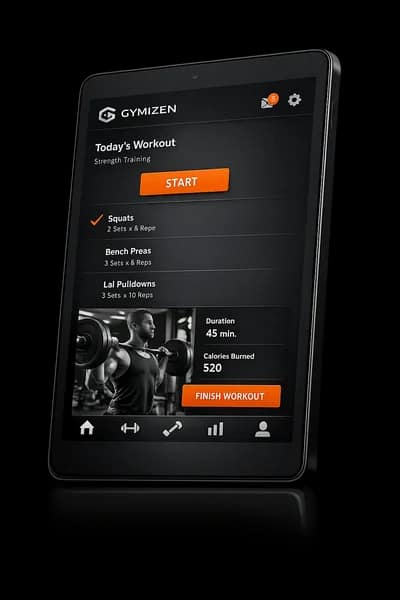


Rolling out a new member app can either (1) reduce front desk load, improve attendance reliability, and strengthen retention—or (2) trigger a week of “I can’t book,” “my pass disappeared,” and policy confusion that forces your team into reactive support. This playbook is designed for the operator-led path: you’ll launch the Gymizen member app in a controlled way, with QA gates, staff rehearsal, and approval-gated member communication so the experience feels simple to members and predictable to staff.
The goal isn’t “download numbers.” The goal is behavior change: members reliably book, show up, manage their own profiles, and understand your rules (late cancel/no-show, waitlist, holds, billing) without your team becoming the help desk.
What “success” looks like (define it before you launch)
Before you send a single app invite, decide what outcomes you’re optimizing for. Here are operator-grade success criteria you can copy/paste into your launch doc:
- Adoption: 60–75% of active members complete first login within 14 days; 80–90% within 30 days (depends on how “active” you define active).
- Self-service shift: bookings and cancellations via app rise week-over-week; inbound “can you book me?” requests at the front desk decline.
- Fewer policy surprises: late cancel/no-show disputes decline because rules are visible and consistent at booking time.
- Data quality improvement: fewer duplicate profiles; more complete phone/email records; member profile edits are logged and handled through a consistent workflow.
- Retention signal: fewer “quiet churn” patterns (members slipping into irregular attendance without anyone noticing). App adoption is not retention by itself, but it enables your proactive ops.
Prerequisites (don’t skip—this is where most rollouts break)
Most app rollouts fail for one of two reasons: (1) account data isn’t clean enough for frictionless login, or (2) your booking rules aren’t consistent, so the app “surprises” members. Treat prerequisites as a hard gate.
Prerequisite A: Member identity and contactability are reliable
- Each member has one primary profile (no duplicates).
- Email addresses are present for the majority of members (or phone numbers if your login flow uses SMS).
- Names are human-readable (avoid “TEST,” “Unknown,” or family-shared emails if possible).
- You have a documented process for “I used the wrong email” or “I can’t access my account” that front desk can execute consistently.
Prerequisite B: Booking rules are stable enough to expose to members
The app makes your rules visible. If your rules are currently enforced by “front desk discretion,” you’ll feel pain during rollout. At minimum, confirm you have clear defaults for:
- Booking window (how far ahead members can reserve).
- Cancellation window and whether it differs by class type.
- Waitlist behavior (auto-add timing, notification, confirmation requirement, and cutoff).
- Capacity caps and whether certain memberships/packs are restricted.
- Drop-in rules for trial guests vs. members.
Prerequisite C: Staff roles and approvals are already decided
App rollout increases the number of member-initiated actions. Decide now who can approve exceptions, edits, credits, and policy overrides. If you wait, you’ll end up with ad-hoc decisions and inconsistent outcomes.
- Owner/GM: final approver for policy exceptions and systemic changes.
- Ops/Studio manager: day-to-day approver for member account edits and rule exceptions within defined bounds.
- Front desk: executes the documented workflow; escalates anything outside guardrails.
- Coaches: should not be forced into account troubleshooting during class (define what they can and can’t do).
Recommended defaults (opt for fewer surprises, not maximum flexibility)
During rollout, your best friend is consistency. You can always get more nuanced later. Start with defaults that reduce edge cases and support load.
Default 1: One policy per behavior (avoid “special rules” at launch)
If you currently run 6 different cancellation windows depending on instructor/class type/day-of-week, the app will amplify confusion. For launch, standardize (even temporarily) to a single cancellation window and a single waitlist behavior wherever possible.
Default 2: Use approval gates for anything that costs money or changes access
Put approvals between staff and actions that create revenue leakage or policy drift. Examples to gate (by role):
- Refunds, credits, comped charges.
- Late cancel/no-show reversals.
- Membership freezes/holds outside standard policy.
- Manual membership plan changes or proration exceptions.
Default 3: “Help desk” boundaries for coaches
Members will ask coaches about app issues. Decide a script coaches use (and where they send members) so class time doesn’t become technical support. Example: “Totally—front desk can fix that in 60 seconds. Please see them after class or message the studio line.”
Role-by-role responsibilities (who owns what during rollout)
Rollouts fail when “everyone owns it,” which means no one owns it. Assign responsibilities per role and create one shared checklist.
Owner / General Manager (final approver)
- Approves final booking rules shown to members (windows, waitlist, penalties).
- Approves rollout timeline and which segments get invited first.
- Approves member-facing messages (tone + policy language).
- Sets “exceptions policy”: what staff can do without asking, and what must be escalated.
Ops / Studio Manager (rollout lead)
- Builds the rollout checklist and runs the QA rehearsal.
- Trains front desk on the top 10 app support scenarios.
- Owns the “issue log” (what’s breaking, how often, root cause, fix).
- Monitors adoption metrics and reports weekly to owner/GM.
Front Desk (execution + member support)
- Helps members log in and confirms their profile is correct (email/phone).
- Resolves duplicates using the documented workflow (or escalates).
- Documents recurring issues in the issue log (exact member report + screenshot if possible).
- Uses only approved exception paths (no “quick fixes” that create future problems).
Coaches (adoption nudges, not troubleshooting)
- Mentions the app at the end of class with a 10-second script.
- Directs members to front desk for any login/account issue.
- Flags pattern issues to the studio manager (e.g., multiple people couldn’t find a specific class).
The approval-gated communication workflow (so you don’t spam or contradict yourself)
Treat member communication like you treat billing configuration: it needs review, a clear owner, and a record of what went out. This keeps your messaging consistent across email/SMS/in-person scripts—and prevents accidental policy drift (“front desk told me X”).
Create a single “source of truth” message pack
Build a small message pack that every channel pulls from. Keep it short and operational, not marketing-heavy. Include:
- What’s changing: “Bookings and waitlists will now be managed in the Gymizen member app.”
- Why it’s better: “Faster booking, easier schedule visibility, fewer missed classes.”
- What members need to do: “Download, log in, and confirm your profile.”
- Rules snapshot: cancellation window, waitlist cutoff, and no-show/late cancel policy phrased plainly.
- Help path: “If you can’t log in, see the front desk or message [studio contact].”
Approval gates (who signs off before anything goes out)
- Draft: studio manager writes message pack + scripts.
- Policy review: owner/GM confirms policy language matches how penalties/exceptions will actually be handled.
- Front desk review: front desk lead sanity-checks for “what questions will members ask?”
- Final approval: owner/GM approves the exact text and the send schedule.
- Post-send QA: studio manager monitors replies/issues for 48 hours and updates the issue log.
QA checklist (run this before inviting members)
Do a rehearsal with test accounts and a small internal pilot. Your goal is to surface the “death by 20 paper cuts” problems (wrong contact info, confusing schedule naming, unexpected booking restrictions) before your entire member base finds them in one day.
QA 1: Identity + login
- Test member can receive login link/code via your chosen channel (email/SMS).
- Profile details display correctly (name, membership/pass status).
- If the test member has a common edge case (shared email, changed phone), the front desk workflow resolves it without admin-level access.
QA 2: Class discovery and schedule clarity
- Class names make sense to a new member (avoid internal jargon).
- Locations/rooms are clear if you run multiple spaces.
- Class descriptions include critical constraints (bring wraps, beginners ok, etc.) without being a novel.
QA 3: Booking rules
- Booking works for each product type you sell (membership, pack, drop-in).
- Cancellation window is enforced exactly as communicated.
- Waitlist flow behaves as expected (join, notification, confirmation, cutoff).
- A member can see “why” they can’t book (e.g., no credits, outside window) rather than a confusing failure.
QA 4: Attendance + check-in reality test
Run one real class where staff uses the normal check-in flow while 5–10 pilot members book via the app. Verify:
- Roster reflects app bookings quickly enough for front desk operations.
- Late arrivals and add-ons can be handled without breaking policy.
- If a coach needs attendance accuracy for pay/metrics, the workflow holds up under pressure.
The 21-day rollout timeline (with gates and checkpoints)
This timeline assumes you want a controlled launch that protects member experience. Compress it if you must—but keep the gates. The gates are what prevent “mass confusion Monday.”
Days 1–3: Prepare the workspace and pick the first pilot segment
Pick a pilot group that’s engaged but not high-maintenance. Your goal is to validate workflows, not to run a focus group.
- Confirm prerequisites: data quality, booking rules, staff roles.
- Select pilot group: e.g., 25–50 members who attend 2–4x/week.
- Create the issue log: a shared doc with columns: date, member, issue, severity, root cause guess, fix, owner, status.
- Draft the message pack and route for approvals.
Gate: Owner/GM approves the pilot segment and the pilot message (what to do if things go wrong).
Days 4–7: Internal rehearsal + staff training (before members see anything)
Your staff should experience the flow before members do. Train for speed and consistency.
Front desk training agenda (60 minutes)
- Login troubleshooting (10 min): wrong email, typo, changed phone, duplicate profiles—what to do and what not to do.
- Booking troubleshooting (15 min): can’t book because of window/credits/restriction; how to explain it without sounding punitive.
- Waitlist expectations (10 min): what “waitlisted” really means, how notifications work, and what’s fair.
- Escalation rules (10 min): what needs manager approval (refunds/credits, reversals, special exceptions).
- Scripts (15 min): the two sentences you’ll repeat all week—make them consistent.
Gate: Studio manager signs off that front desk can resolve the top 10 scenarios without improvising policy.
Days 8–10: Pilot launch (invite, support, and fix the first wave of issues)
Invite the pilot group with a simple, specific ask: download, log in, book one class, and confirm their profile details.
- Day 8: Send pilot invite. Front desk is briefed on who’s in pilot and what to do if they get questions.
- Day 9: Run a “support window” (e.g., 4–6pm) where a manager is on-site to handle escalations quickly.
- Day 10: Review issue log, categorize issues: data issues vs. policy clarity vs. true software bug vs. training gap.
Gate: Owner/GM approves moving from pilot to full rollout only after the top recurring issue is fixed (or has a documented workaround).
Days 11–14: Expand rollout to your “core” members (the adoption accelerant group)
Now invite the members most likely to adopt quickly and create social proof. This is where you build momentum without overwhelming staff.
- Invite members who attended within the last 30 days (or last 45, depending on seasonality).
- Run in-studio reminders with a QR code at front desk (keep it optional but visible).
- Coaches deliver the 10-second close: “Book in the app so you don’t lose your spot.”
- Studio manager tracks: logins, failed logins, top 3 confusion points.
Days 15–18: Full member base invite + policy reinforcement (without sounding like a threat)
By now, your process should be stable enough that expanding won’t flood your staff. Keep messaging focused on convenience and clarity.
- Send the full invite with a short “what changes / what stays the same” section.
- Post a simple in-studio FAQ: login help path, booking window, cancellation window, waitlist behavior.
- Front desk uses the same script every time (consistency reduces conflict).
Days 19–21: Stabilize, audit, and lock in the operating rhythm
The final stage is not “send one more message.” It’s stabilizing the workflow so the app becomes the normal way members interact with your studio.
- Audit exceptions: review all overrides/credits/reversals that happened during rollout. Were approvals followed? If not, tighten the gate.
- Standardize support: create a one-page SOP for the top 10 questions and store it where front desk can find it fast.
- Measure adoption + friction: identify which member segment is stuck (often: older members, family/shared emails, or semi-active members).
- Plan a final nudge: a short reminder targeted only to members who haven’t logged in (avoid spamming everyone).
Gate: Owner/GM signs off that the new “booking + support” process is the default operating model going forward.
Common mistakes (and how to prevent them)
Mistake 1: Rolling out to everyone before the first pilot class runs
If you haven’t run one real class with pilot members booking through the app, you haven’t tested the workflow. Do not confuse “it worked in a test account” with “it works at 5:30pm when 28 people are arriving.”
Mistake 2: Letting staff “make exceptions” without documenting them
During rollout, exceptions feel compassionate—and then become precedent. Require a reason code or a short note for exceptions, and route anything financial through approvals. Your future self (and your margin) will thank you.
Mistake 3: Over-explaining in member messages
A long email about every possible edge case reduces adoption. The message should cover (1) what to do, (2) why it helps, (3) what to expect, and (4) where to get help. Put edge cases into an FAQ or let front desk handle them with SOP.
Mistake 4: Coaches becoming the support channel
This burns coaches out and degrades class experience. Give coaches a script and a handoff. If coaches must do something in the moment, keep it limited to directing the member to the correct help path.
Operational metrics to monitor (first 30 days after launch)
Track adoption, but also track operational stability. The app is a workflow change; measure whether the workflow is working.
- Login completion rate (by member segment: active vs semi-active).
- Booking channel shift: percent of reservations made via app vs staff.
- Support volume: number of app-related help requests per day (should spike then decline).
- Exception count: late cancel reversals, credits, manual overrides (should be reviewed weekly during rollout).
- Waitlist conversion: how often waitlisted members successfully get in and attend (signal of integrity and clarity).
Quick-start scripts (copy/paste for staff)
Coach close (10 seconds)
“Quick reminder: please book your next class in the Gymizen app—waitlists and openings move fast, and this is the easiest way to hold your spot.”
Front desk login help (15 seconds)
“No problem—let’s get you in. What’s the best email or phone for your account? Once you’re logged in, you’ll be able to book and manage everything from here.”
Policy clarity without sounding punitive (20 seconds)
“Because classes fill up, we keep the same cancellation window for everyone. That way waitlisted members get a fair shot and coaches can plan. If something unusual comes up, we can take a look—just message us.”
Conclusion: launch the app like an operating system, not a feature
A member app rollout is a retention and operations project disguised as a tech task. The win is not the download—it’s the consistent member experience: clear booking rules, reliable waitlists, fewer exceptions, and a front desk that isn’t trapped in manual scheduling all day. If you follow the 21-day plan with real QA gates and approval-gated communication, you’ll get adoption without chaos—and you’ll set the foundation for proactive retention workflows that scale as your studio grows.
If you want to go further after app adoption stabilizes, the next step is using what the app enables: better segmentation, cleaner operating rhythms, and automation with approvals so you can be proactive without accidental messages or policy drift.